

This Is The Most Expensive Man-Made Object Ever Produced
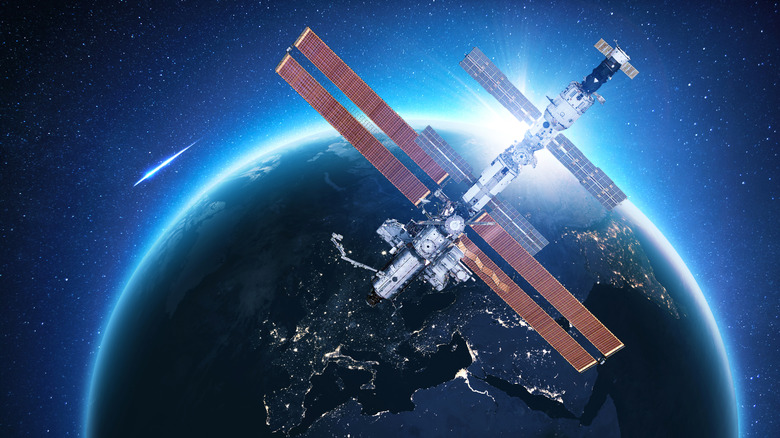
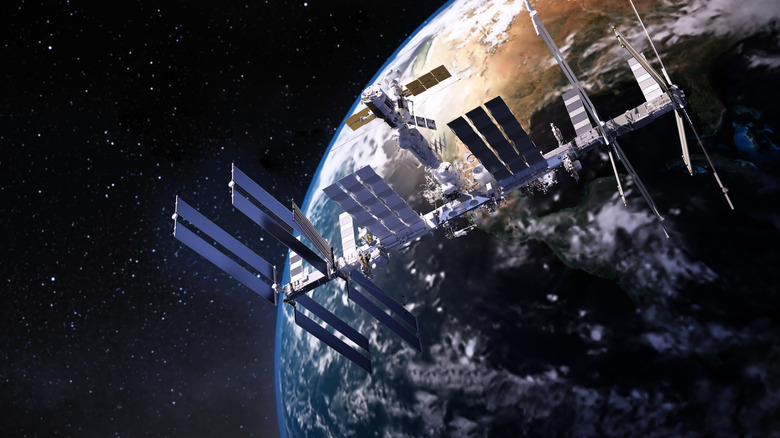
When we envision extraordinarily expensive objects, the first items that come to mind are usually paintings by some medieval maestro, a billionaire's superyacht, or a one-of-a-kind car. But the priciest object that mankind has ever made isn't sitting here on Earth, but floating above the sky. We're talking about an object that is arguably the best example of multinational collaboration in the modern age, and has served as a pillar for humanity's quest to become an interplanetary species. Say hello to the space station, a technical marvel that also holds a Guinness World Record as the most expensive man-made object ever. In 2030, the massive floating station will be retired. The whole structure is so complex and massive that the decommissioning mission is going to cost nearly a billion dollars.
So, how much did it actually cost to build? The European Space Agency (ESA), which has been a core member of the space station project since its inception, estimates the cost at around EUR 100 billion (approximately $117 billion). But according to more estimates, the space station has apparently run a bill worth $150 billion to develop and build. That's more than the annual GDP of numerous countries across Europe, Asia, and the African continent, as per the latest data accumulated by the International Monetary Fund (IMF).
In addition to the staggering construction cost, NASA is currently burning through three billion dollars each year in operational costs and maintenance, as per a 2021 audit, while the net cost of this exercise is closer to four billion dollars and shared among partner nations sharing a residence. As per the ISS Program Office, the annual operating costs will remain "stable" at $3.2 billion per year until it's gradually decommissioned.
A tale of cost overruns
The first expedition to take residence on the space station landed towards the end of 2000. But the journey was not without its fair share of setbacks. An astronomical budget was one of the biggest concerns. The original cost of the project conveyed to Congress was just $8 billion, but by 1990, the estimates had already shot past a projected $120 billion. Citing experts, The New York Times described it as a "case study in cost escalation." During a U.S. House of Representatives hearing in 2001, it was revealed that the US portion of the ISS was supposed to cost $17.4 billion as of 1993, but rose to $21.3 billion by 1998, and swelled further over the years.
One of the main culprits was iterations, or as the hearing's Congressional Research Service member Marcia S. Smith put it, "redesign followed redesign." Redesigns meant heavily modifying or scrapping prior work, re-engineering, and extra integration and testing costs. The hearing also highlighted a bevy of issues, such as delayed schedules (compounded by inflation, increasing labor and material costs), hardware going obsolete midway through the project, underestimating the complexity of tasks such as life support systems, hardware failures, and missed contribution targets by Russia due to funding shortages and technical shortcomings.
The absence of mandatory annual independent audits and poor life cycle cost projections also contributed to billions in cost overruns. Notably, the cost estimates excluded the price of launches. During the time of the hearing, it was revealed that the estimated costs exclude launch missions, of which over 70 were still needed to reach the assembly-complete stage of the station. Also excluded from the costs were salaries and operational costs. The launch missions are pretty expensive on their own. In 2006, NASA was paying a hefty $21.8 million per seat for a space station trip.
A brief history and cost perspective
In 1972, President Nixon approved the space shuttle program, and following the success of the Skylab space station that was built atop the Apollo infrastructure, plans for the ISS began. It was in January of 1984 when plans for making a floating and habitable orbital station first kicked into motion. In-orbit construction kicked off in 1998, and two years later, humans had found a permanent living space on the station. The signing of the Inter-Governmental Agreement (IGA) 1998 proved to be a pivotal moment, and within a year, on-orbit construction kicked into action.
The station started as a joint project among the United States, Japan, Canada, Russia, and 11 countries that were members of the ESA back then. Interestingly, some of the partners also contributed to the ballooning space station costs. A 2002 GAO report mentioned how the Russian Soyuz vehicles didn't meet quality standards, prompting NASA to spend $1.5 billion to build a crew return vehicle. Additionally, every month of a slipped schedule piled $100 million in extra costs. SpaceX, which has single-handedly brought down the cost of space missions, will also be the one dismantling the space station at a cost of nearly a billion dollars.
In the cost hall of fame beyond the space station, we have Chevron's Gorgon gas plant at an estimated value of $54 billion, and UK's Hinkley Point C reactor plant at an estimated cost of $43 billion. The Starlink satellite constellation has incurred an investment to the tune of $20 to $30 billion, per Elon Musk.