

What Happens If A Navy Ship Loses Power At Sea?
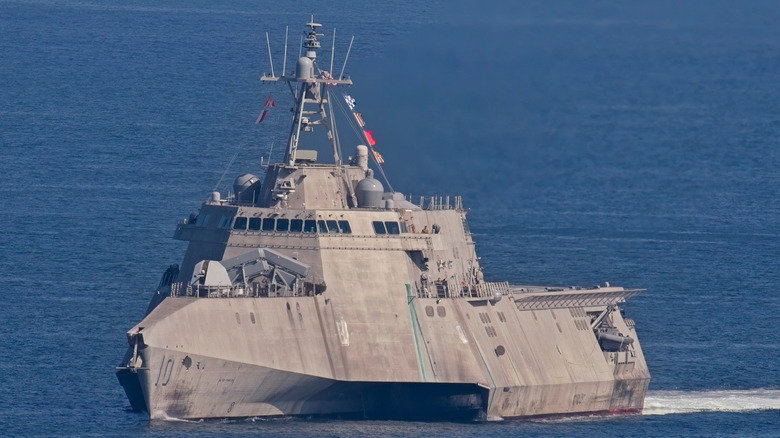
When a U.S. Navy ship experiences a power loss at sea, sailors have standard procedures they follow to ensure the safety of everyone onboard. While these procedures are in part described by the Navy's Engineering Operational Sequencing System (EOSS) along with other protocols, the details of these procedures aren't publicly available. Plus, it varies from ship to ship. Nevertheless, one way to get an idea of what happens if a Navy ship loses power is to look back at blackout situations from the past in which crews had to respond.
The USS Detroit, a part of the fastest class of ship in the Navy, lost power in 2020 on its way back to Florida from Latin America. The crew immediately conducted an assessment to discover the problem. In the end, however, there was very little that could be done while at sea, so the Detroit was eventually towed back to port. The USS Fitzgerald's situation in 2017 was much worse. The Fitzgerald violently collided with a merchant ship, resulting in a sudden power loss. Amidst the chaos, the crew scrambled to perform emergency damage control and rescue trapped personnel. Though the ship's systems were beyond repair, sailors managed to stabilize the Fitzgerald and bring it back to port in Yokosuka, Japan.
The USS Freedom also experienced a propulsion shutdown in 2013 due to overheating diesel generators. While this wasn't a total loss of power, it did reduce the ship's ability to maneuver. When the incident happened, emergency systems automatically kicked in. Sailors worked with technicians to find the problem and restore normal operations. The Freedom returned to port for repairs the following day.
How the U.S. Navy minimizes risk of a blackout on its ships
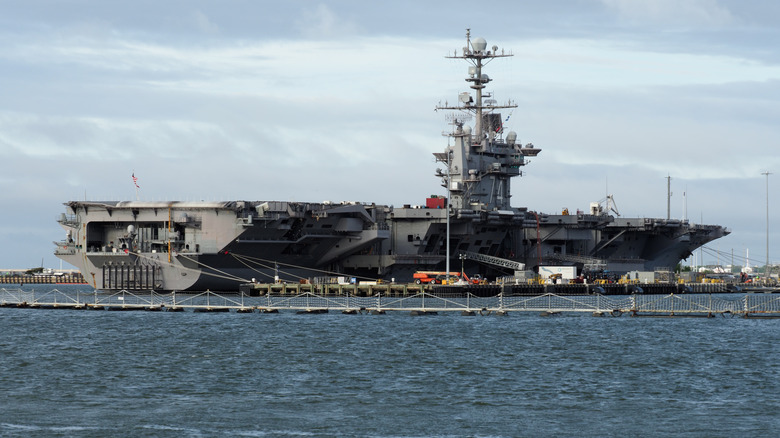
Although total power loss is possible onboard ships, the U.S. Navy works to minimize the risk through multiple generators that can operate at the same time. This parallel operation allows for other generators to come online before any overloads can occur. So even if one generator goes out, it shouldn't result in a total blackout of the ship. However, if power does go out, emergency systems are designed to maintain the most critical loads, including communications.
Still, even the Navy's aircraft carriers can suffer from power-related problems on the ocean. In 2013, the USS Nimitz, an iconic carrier that's approaching retirement, experienced an electrical fire while deployed in the Indian Ocean. The ship's firefighting team stepped up to put out the fire, while crew members worked to maintain operations so the vessel could continue with its mission.
Two of the oldest aircraft carriers still in service, the USS George Washington and USS John C. Stennis, were both found to have problems with their turbine generators in 2024. This essential electrical component is responsible for powering everything from the ship's radar to communications and crew support. However, things could've been much worse, as these problems were discovered while both carriers were being refitted before being returned to duty.