

'Snake Vision' System Could Make 4K Thermal Imaging A Reality

For centuries, mankind's greatest technological leaps have begun with a simple act: observing nature. Our desire to fly high was inspired by birds' ability to soar the skies. Our fascination with marine life — and the ocean, in general — eventually helped us design and build submarines, boats, and some of the biggest ships ever seen; inventions that went on to become the backbone of trade and warfare. This practice of learning from natural design forms an area of study known as biomimicry, and this tendency to borrow ideas from nature is far from over.
A recent example comes from a group of scientists at China's Beijing Institute of Technology, who have developed an artificial vision system inspired by certain snake species. Informally called "snake vision," this technology — as outlined in a paper published in Light, Science & Applications — mimics the heat-sensing capability of pit vipers, a species of snake that has evolved to detect infrared radiation emitted by warm bodies, allowing them to "see" and hunt for prey even in complete darkness.
The goal of this new technology is to close the gap between current night-vision cameras and the sharp, high-resolution images we get from normal cameras. Consumer-grade night-vision systems often produce grainy or blurry imagery because they rely on their own infrared illumination and cannot detect the natural infrared radiation that objects emit. Snake vision solves this problem by giving a standard camera sensor the ability to detect this naturally emitted infrared with far greater clarity. In simple terms, it lets an ordinary camera sensor capture clear, detailed images in complete darkness — something conventional low-cost night-vision cameras struggle with.
The connection between thermal imaging and snake vision tech
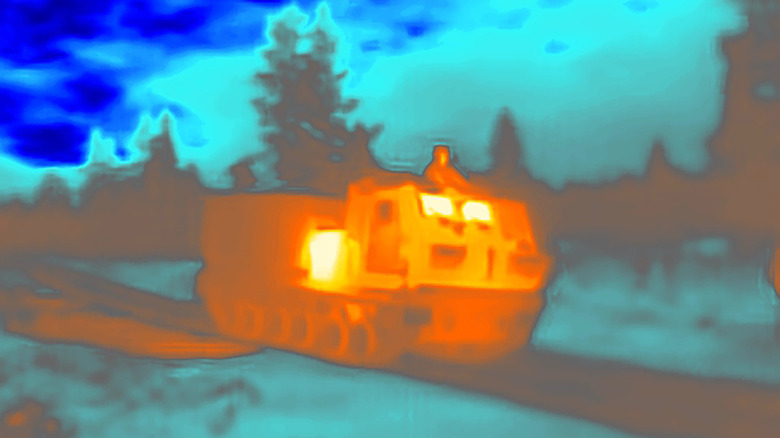
This newly developed snake vision technology operates very differently from the current crop of consumer-grade night-vision-capable surveillance cameras. Consumer-grade surveillance cameras typically use an inbuilt infrared light that's invisible to the human eye to see in the dark. Think of it like a flashlight that emits a beam of light only visible to the camera sensor.
In contrast, thermal imaging — which is what this snake vision camera does — works by detecting the natural heat radiation emitted by objects. There is no LED illumination in play here at all. Thermal imaging has found use in several applications, ranging from firefighting and military surveillance (including night vision goggles) to industrial inspection, search-and-rescue, and night vision binoculars. While thermal imaging equipment already exists — including add-on thermal camera attachments designed for smartphones — the technology suffers from several issues in its current form. These range from low-resolution images and poor color accuracy to high maintenance costs, making it impractical for everyday security use.
This is where the new snake vision technology comes in. Instead of emitting infrared light or relying on expensive thermal sensors, scientists at the Beijing Institute of Technology have developed a modified CMOS sensor that's similar to those used by modern smartphones. This modification allows the sensor to "see" otherwise invisible infrared radiation, while maintaining its ability to capture images with the resolution and clarity we're used to.
How does snake vision tech work?

To understand how snake vision technology works, it's important to remember that every object around us continuously emits infrared radiation. In colloquial terms, it means these objects are continually emitting or absorbing heat. This process happens constantly, even in complete darkness, and occurs far outside the frequency range our eyes (or ordinary camera sensors) can detect; thus, it is, for all intents and purposes, invisible. Traditional thermal imaging cameras can see these emissions, but need specialized (and expensive) materials and cooling systems to do so.
Snake vision technology essentially simplifies this process by inserting a special quantum-dot layer between the various layers that make up a CMOS sensor. This layer is what allows the sensor to detect infrared radiation and convert it into visible light. Think of this layer as a kind of translator that absorbs the incoming invisible radiation and converts that energy into visible-light photons, which the CMOS sensor can detect.
Once this conversion occurs, the sensor can "see" the infrared radiation as it would a regular image. What is even more incredible is that the sensor can capture this radiation while preserving the sharpness and detail that modern CMOS sensors can offer. As a result, you get a crisp, detailed thermal image that far surpasses what traditional thermal cameras can deliver. Snake-vision, then, reveals an entirely new world of otherwise invisible heat, just with the simplicity and clarity of modern digital photography.