

Can You Use WD-40 As Dielectric Grease?
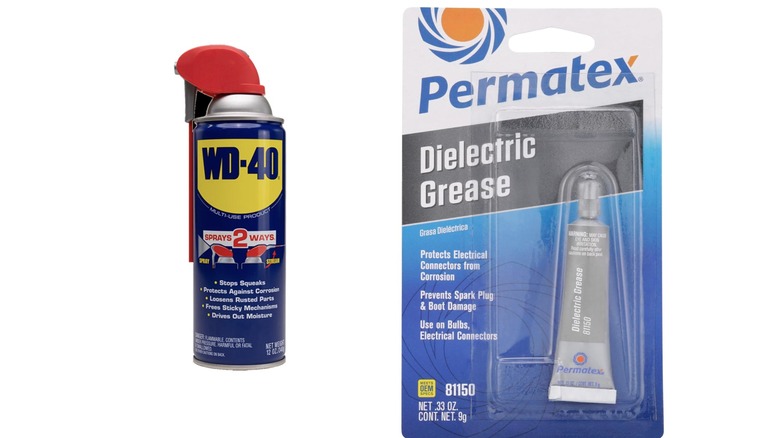
If you're a home mechanic you've probably dealt with dielectric grease at some point. This silicone gel lubricant creates a barrier that prevents water from getting into wiring connectors and onto battery terminals where it could corrode or rust them until they no longer conduct electricity. You should also put a thin layer of dielectric grease inside new spark plug boots when you change the wires, as it can prevent rainwater from knocking out your ignition system. And given that the WD in WD-40 stands for 'water displacement,' you might assume that it can double as a dielectric grease. Both products are made to help control moisture, used around electrical components, and commonly found in garages and toolboxes.
Despite these similarities, WD-40 is not a substitute for dielectric grease. WD-40 quick-drying contact cleaner is safe and effective for use on battery terminals and wiring connectors, but it doesn't create the insulating and long-lasting barrier that dielectric grease does. Another issue with using WD-40 instead of dielectric grease is that the film it leaves behind attracts dirt and grime that can interrupt or short out important circuits. And because WD-40 is highly flammable, using it near electrical components that might generate sparks is unsafe and unwise.
WD-40 makes a dedicated electrical parts cleaner
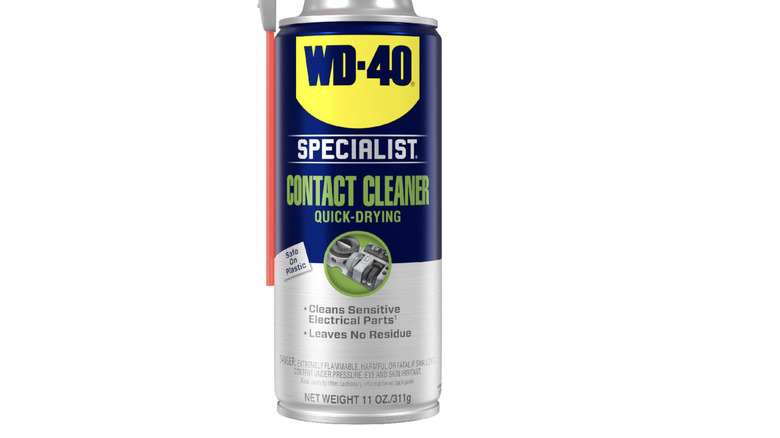
While you can't use WD-40 multi-use product as a dielectric grease, the company makes another product suitable for use on your car's electrical system. The WD-40 electric parts cleaner pictured above is safe for use on delicate components like sensors and circuit boards and won't leave behind a film that attracts gunk. Save the multi-use WD-40 for these unexpected uses or freeing rusty fasteners, and use all WD-40 products outdoors or in a well-ventilated area. If you're going to use it for an extended period, a face shield with goggles and respirator is a must-have. The solvents in WD-40 are toxic to the mucus membranes in the eyes, respiratory tract, and other organs and can make you seriously ill if you inhale or ingest them.
Using WD-40 Specialist contact cleaner to clean dirty or corroded battery terminals is a simple task. Disconnect the terminals, spray generously and let sit for a few minutes, scrub them with a wire brush, and use a dry lint-free cloth to wipe them clean before applying a thin film of dielectric grease. There is one situation where using WD-40 multi-use spray on electrical components is advised, though. If electrical connectors get wet from inclement weather or engine cleaning, a blast of WD-40 where connectors meet can flush out any accumulated water.