

5 Of The Most Powerful Aircraft Carriers Sailing The Seas In 2026
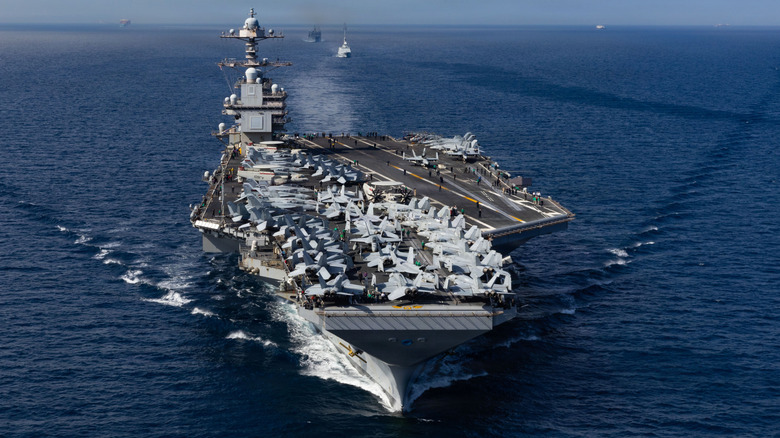
While the scope and technology of naval power have evolved immensely in the 80 years since World War II ended, the aircraft carrier continues to be one of the most powerful and important weapons on the face of the earth. It's not just that the aircraft carrier remains of vital importance to today's navies for its essential combat capabilities, but also for the high-profile way these ships project and symbolize a nation's geopolitical power. As you might expect, the carriers of the U.S. Navy reign supreme in both of these departments, and the competition isn't really close. But with new aircraft carrier classes replacing old ones, as well as new ships being introduced by other countries, there's a lot happening right now across the world of global carrier power.
As we move through the second half of the 2020s, the carriers sailing the world's oceans have never been more impressive from a technical standpoint. They are also immensely powerful — whether you are talking in terms of the actual horsepower that moves them across the sea, or in their broader fighting capability. With this in mind, we've rounded up five of the most powerful aircraft carriers on the oceans today, including the top-dog nuclear carriers, conventionally-powered carriers, as well as amphibious assault carriers.
Nimitz-class (US Navy)
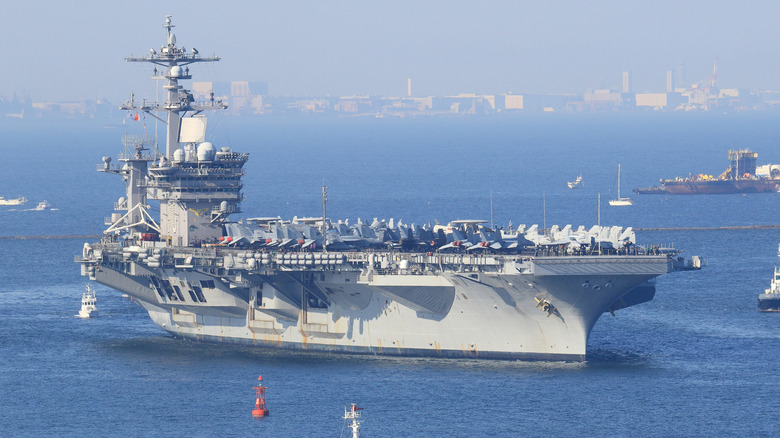
If you want to get an idea of just how dominant the U.S. Navy is when it comes to carrier power, just look at the Nimitz-class carriers. By many standards, these carriers are ancient, having been in service for over 50 years now, and now heading into their retirement years. Yet, their raw power and capabilities are still game-changing.
Fed by two nuclear reactors with unlimited operational range, the Nimitz can make up to 260,000 horsepower, and can travel in excess of 30 knots. This is very impressive considering their size and 100,00 ton displacement. But maybe not as impressive as the Nimitz-class aircraft arsenal, which can consist of up to 130 F/A-18 Super Hornets if needed. And don't forget its whole range of missile systems and machine guns, either.
It's only fitting that the only aircraft carrier more powerful than a Nimitz-class ship would be its replacement, the Navy's newer Gerald R. Ford-class ships. Sure, the USS Nimitz might be the oldest American aircraft carrier still in service, and one that's scheduled to be retired very soon. But the Nimitz, along with the rest of the carriers in its class, still represents unmatched naval power by any global historical standards. The later ships of the class will still be on the seas protecting American interests for a long time to come.
Fujian (China)
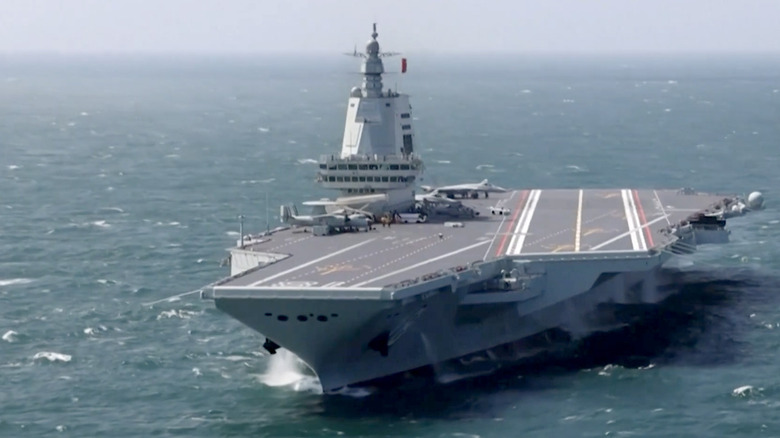
At the time the aforementioned Nimitz-class carrier launched in the 1970s, the idea of a state-of-the-art Chinese aircraft carrier would have been absurd. But a lot has changed in 50 years, and today the new 'unsinkable' Fujian carrier is a symbol of China's increasingly advanced and ambitious People's Liberation Navy. Though it's powered by steam turbines rather than nuclear reactors, the 280,000-horsepower Fujian is one of the largest carrier types sailing today, and is said to be paving the way for nuclear-powered Chinese carriers coming next.
Because Fujian is such a new ship, and because China's military information is heavily guarded, it's hard to figure out exactly where this carrier places within the global power rankings. The Fujian can carry around 60 aircraft, including China's latest fifth-generation fighters, and the ship also has a high-tech electromagnetic launching system to quickly get its planes in the air. Even if it turns out not to be quite the dominant warship that China hopes it will be, the Fujian still represents a big step forward in naval power for one of America's chief geopolitical rivals. There's no doubt the U.S. Navy and its allies are going to be keeping a close eye on the Fujian to learn more about how it performs in the real world.
Queen Elizabeth-class (Royal Navy)
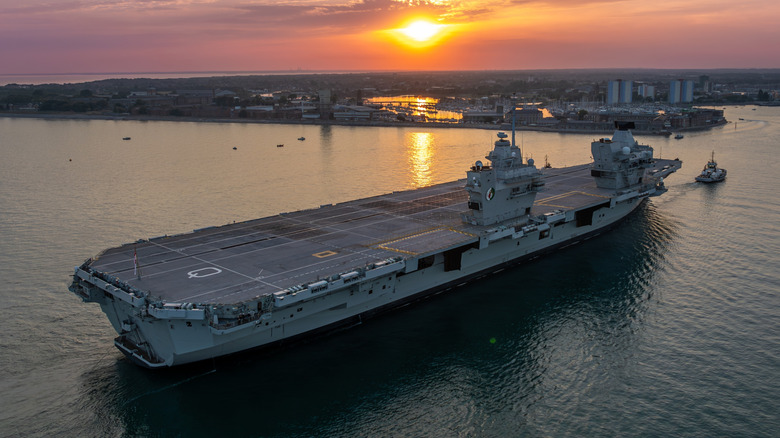
The current Royal Navy might not be anywhere near the immense, globe-spanning force it once was, but its Queen Elizabeth-class carriers are very impressive ships in their own right. At the moment, there are just two ships in the class, the namesake HMS Queen Elizabeth along with the U.K.'s newest carrier, the HMS Prince of Wales. There are also some key differences between the Queen Elizabeth-class and some of the carriers on this list, and not just in the unique look it gets from its twin islands.
Unlike the U.S. Navy's large carriers, the Queen Elizabeth-class is conventionally powered, with a pair of gas turbine engines that generate about 100,000 horsepower combined. This gives it a top speed of about 25 knots, with a range of over 10,000 nautical miles. There's also the fact that it doesn't carry traditional fixed-wing aircraft. Instead, these ships are dedicated to carrying STOVL aircraft and a variety of helicopters.
The Queen Elizabeth-class can carry up to 36 F-35B Lightning II aircraft. These are the vertical take-off and landing variant of the popular jet fighter. Even with the shrunken size of the modern Royal Navy, the Queen Elizabeth and Prince of Wales are nonetheless two of the largest and most technically advanced vessels the U.K. has ever sailed.
America-class (US Navy)
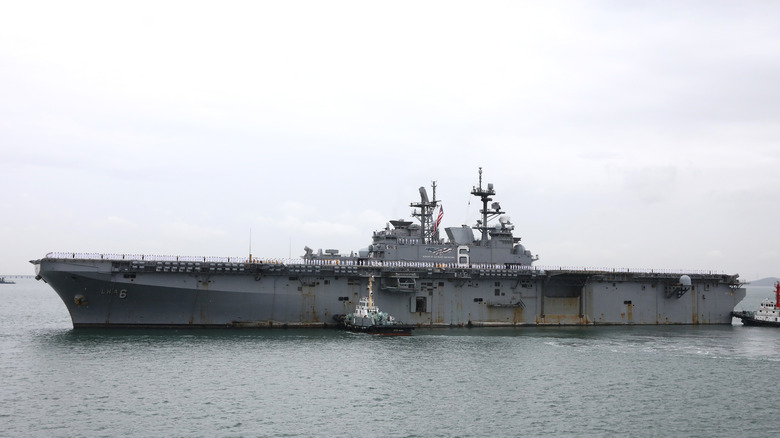
While most of the attention naturally goes to America's flagship nuclear-powered aircraft carriers, the U.S. Navy's amphibious assault ships are equally impressive in many ways. Sure, these ships might be designed to perform a different mission than traditional navy aircraft carriers, but relatively speaking, they still represent some of the most powerful aircraft-launching vessels in the world. The America-class ships are the U.S. Navy's newest amphibious assault ships, and they were developed with an even greater emphasis on aviation than earlier ships.
America-class ships are powered by a pair of gas turbine engines that make 70,000 horsepower and can do over 20 knots on the ocean. Their aircraft arsenal can include a variety of attack and transport helicopters, as well as MV-22 Osprey tilt rotor aircraft and F-35B Lightning II fighters. And they can do all of that while also carrying and launching traditional landing craft and hovercraft for amphibious operations.
These ships might not be 'real' aircraft carriers, but their versatility is unmatched. That's whether the fighting is on the ocean, in the air, or on the ground. Or to put it more simply, these American 'non-carriers' would be the largest and most powerful aircraft carriers in most navies throughout the world and throughout history.
Gerald R. Ford Class (US Navy)
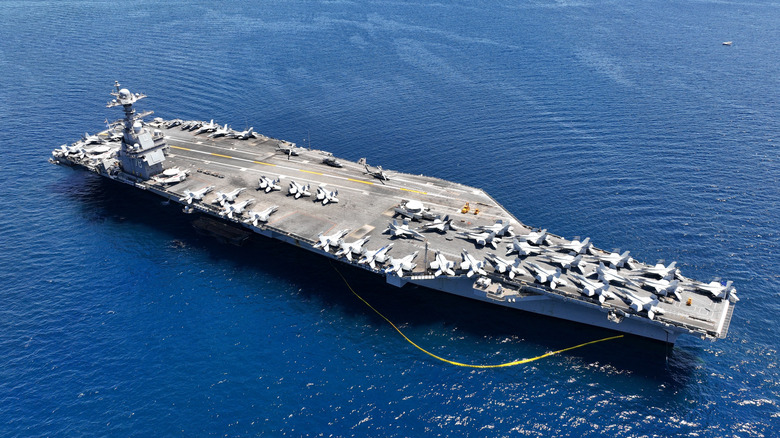
Last but not least, we get to the world's largest and most powerful aircraft carrier, the U.S. Navy's Gerald R. Ford-class. After the older Nimitz-class nuclear carriers dominated the oceans in the late 20th and early 21st centuries, the Ford-class represents the next evolution of aircraft carrier capability. Although there have been no actual power output figures published for the Ford-class carriers, their newer A1B reactors are said to be significantly more powerful than the older units on the 260,000-horsepower Nimitz-class ships. The new reactors can also be operated with a smaller crew.
The Ford-class also makes big leaps when it comes to handling aircraft, with a larger flight deck and a new electromagnetic launch system to replace the steam-powered catapults on the older carriers. It also uses similar electromagnetic technology when it comes to the arresting gear used when planes land on the deck. As for its air wing, a Ford-class ship can carry as many as 90 fixed-wing planes and helicopters. So far, construction delays have been an issue, with just the namesake USS Gerald R. Ford having been completed. But as the U.S. Navy continues the long process of replacing the Nimitz-class ships with these larger, more advanced carriers, the Ford-class carriers are planned to be the backbone of the Navy until the year 2105.