

15 Things You Should Never Ask Google's Gemini
We may receive a commission on purchases made from links.
New technology brings wrong expectations. Large language models (LLMs) like Gemini create the illusion of limitless capability because they can write and analyze. This is a mistake, because LLMs are sophisticated text prediction engines, not digital experts. You should always take extreme caution when using any AI for answers to a real problem.
LLMs work by spotting and copying patterns in training data to create a statistically probable, smooth, and convincing sequence of words. Their core design prioritizes fluency over verifiable fact or exact calculation, making them unreliable and dangerous for jobs that need precision. You should never treat them as suitable a substitute for human judgment and output.
There are plenty of things that Google's Gemini LLM will fail at, and it will often opt for an answer that sounds good instead of admitting what it cannot do. Learning about these limits is a key aspect of safely using generative AI, because you'll know what not to ask. This way, you can avoid its tendency toward answers that sound correct instead of being accurate.
Direct URLs and citations
One of the trickiest and most annoying problems with this technology is that Gemini loves to hallucinate links. This can make it unreliable if you need direct URLs or citations. A link may seem legitimate at first glance, but clicking through can lead to 404 errors, or just reveal themselves to be entirely non-functional. This is also a reason not to trust Gemini in your Google workspace account.
The central issue springs from how this technology actually works. Remember, AI is just predicting text strings.The model knows the structure of a URL, but it doesn't automatically browse the live web to check if a destination is real. Basically, it builds the reference using the material it was trained on and the keywords from your request, mathematically guessing what the address should be instead of retrieving a real one. Essentially, it can fabricate a logical web address just like it constructs a fictional sentence, resulting in a citation that goes nowhere.
A method called search grounding — which refers to an LLM using up-to-date search results, rather than the (often old) material it was initially trained on — is meant to fix this issue, but it's not perfect, and not every chatbot uses it. You should be extremely careful when you use Gemini, or any other AI, for answers to serious problems that need verified sources. You can always try to force AI to use better sources, but that requires getting the URLs yourself beforehand.
Exact word counts
You should never count on Gemini to hit an exact word count. It might sound like it should be an easy calculation for a machine, but Gemini is simply not built to precisely trim or count words. That's because large language models don't actually read words as we do. Instead, they chew through tokens. These are just statistically grouped chunks of characters.
This whole tokenization process puts the AI on a totally different level of abstraction. It's looking at numerical values for these chunks, not distinct words, which makes hitting a precise count during the actual writing process almost impossible.
The model doesn't see the individual letters or word breaks inside those processed chunks. Gemini creates responses by predicting what the next most probable piece of information will be. It just can't accurately tally the words in its own text while it's busy predicting the flow. If you absolutely need those precise length limits for your project, you're going to have to do the final trimming yourself, because Gemini can't self-edit for exact length as it goes.
Real-time SEO metrics
Trying to swap out your marketing software for free generative AI is a sure path to strategic trouble. Gemini can't replace expensive professional tools like Ahrefs or Semrush. Even if you ask for the monthly search volume of a keyword, the AI can't just tap into Google's huge internal data vaults. If Gemini responds by confidently spitting out a number, it's not trustworthy, even when formatted to look exactly like something pulled from a legitimate report.
Any response other than a "I don't know" is a total hallucination, because Gemini simply doesn't have access to a live global database of search volume. Unlike the dedicated SEO tools that constantly crawl the web to keep keyword difficulty and traffic stats updated, AI is constrained by its static training data. It's basically just guessing based on information that could be years old, so you absolutely can't rely on it for any current market analysis.
When it lacks specific data, it often hallucinates plausible fillers. The model prioritizes giving you an answer above making sure that it is factually correct.
Biographies of non-celebrities

You really shouldn't ever ask Gemini who your local city council member is, or anyone else, unless they're known across the whole country. While this AI can spit out details about global stars pretty accurately, it really starts to struggle with people or things that aren't widely documented everywhere on the internet. Since the training data for these folks is sparse, the model tries to bridge those gaps using probability instead of actual facts, and that often leads to some seriously weird fabrications.
AI also frequently merges the bios of two different people who just happen to share the same name. If you aren't paying attention, you might suddenly find out your neighborhood baker is credited with the entire political career of a senator from some other state, inventing a fictional composite character and presenting it as if it's the truth.
This failure is based on a broader issue in the model. When data coverage is thin, Gemini prefers making up a realistic-sounding answer instead of simply admitting it doesn't know. It's that kind of thing that could lead to a nightmare scenario in the future that hurts the reputation of others.
True random number generation

You may jump to AI hoping to bypass messy human decisions and get a truly impartial choice, but you absolutely cannot use a model like Gemini to pick a lottery number or, say, flip a coin fairly. Even though the interface makes it look like it's whipping up a number totally spontaneously, the underlying tech just isn't capable of the high-entropy unpredictability you need for genuine chance. In fact, we've never been able to have true random number generation.
That's because computer code relies on a specific "seed" to kick off its random number generation process. LLMs are deterministic systems and use math operations, not messy things like atmospheric noise or radioactive decay, to generate what you see. When you ask for a number, it isn't tapping into some cosmic well of randomness because AI can't generate a random number anymore than a human can.
Since these models are designed to recognize and replicate patterns in language, they are inherently biased toward order. There are plenty of things you should never use AI for, but this is one of those lesser known reasons to stay away from AI for help.
Spatial logic puzzles

You generally shouldn't ask Gemini to handle spatial logic puzzles or try to mentally arrange physical stuff. If you ask Gemini to visualize a stack of blocks and then figure out which one is resting on the floor, it will likely fail terribly. These text-based systems struggle because they're based on predicting language patterns, not simulating physics.
This means the AI loses track of object relationships fast, especially if the description gets complicated. While you or I can easily picture how taking out a bottom block makes a tower fall, Gemini lacks the "physical common sense" needed for those cause-and-effect relationships in a real 3D setting. Yet, some places still think its a good idea to use AI to interview candidates.
This issue with spatial organization isn't just about imaginary blocks, either; it makes them awful at anything requiring perfect counting or strict spatial borders. Remember, you're chatting with a system built to churn out believable sentences, not navigate physical space or use strict logic.
Counting objects in images
Gemini Vision's multimodal features are great because you can easily upload photos for analysis. However, you shouldn't trust it to count specific items, like figuring out how many marbles are actually in a jar. The model is fantastic at describing a general scene, picking up on the mood, lighting, and context to give you a summary that feels insightful and descriptive, but that descriptive ability just doesn't translate into precision.
LLMs are genuinely terrible at precise counting (enumeration), especially when distinguishing between individuals or objects that are crammed close together. When you ask Gemini to count, it's not running a sequential tally the way a person or a typical computer vision program would. Instead, it just generates a probabilistic response based on the visual patterns it detects.
This means it might look at a crowded room and confidently tell you there are 10 people when there are actually 15. Relying on Gemini for this task is a guarantee that you'll get a plausible-sounding answer with a number that is likely incorrect.
ASCII art generation
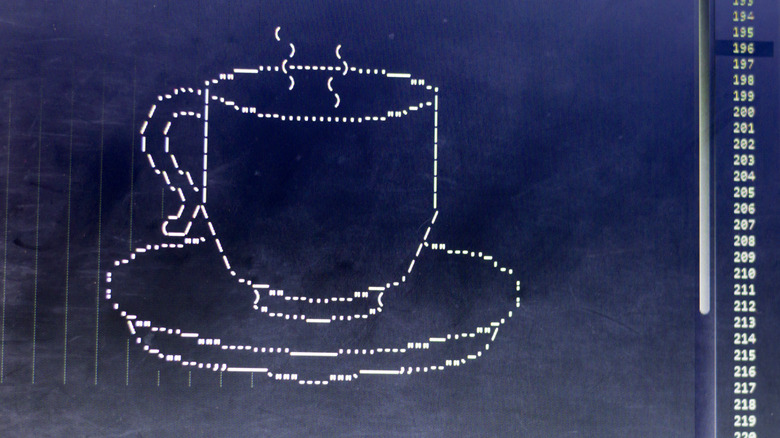
That classic nostalgic ASCII art vibe from the early internet days is not something AI can do well. The fundamental issue is how the model interprets the text. Gemini just doesn't see the precise monospaced font alignment that's required for ASCII art to actually work. It operates solely by predicting the next probable token in the sequence. This means it predicts the characters, but it completely fails to understand the specific line breaks needed to form an actual picture.
Since LLMs process tokens rather than reading words or viewing pixels like we do, they simply can't see the geometric grid necessary for visual alignment. Gemini loses track of the relative position of characters necessary to draw a cohesive shape.
That's because the model is trying to predict the text statistically rather than visually placing symbols where they belong. Asking Gemini to generate ASCII art is kind of like asking a great chef to paint a portrait using only soup; they understand the ingredients, but the fluid medium just refuses to hold the precise structure you require.
Baking substitutions

Baking is chemistry, so ask Gemini how to swap baking soda for baking powder, and you might get a ratio that absolutely messes up the pH balance of your dough. It can recite common knowledge from blogs, but it doesn't have the chemical knowledge to understand when a simple switch is going to make your cake completely collapse.
This difference is crucial. Baking depends on exact reactions between acid and alkaline ingredients to get your desired lift, texture, and flavor. Even though Gemini can access a huge training dataset of recipes, but it can't verify if the knowledge it pulls from the internet is scientifically sound.
The real danger here is that Gemini tends to hallucinate, and it does so with serious confidence. If you try to press it for a source about a weird flour-to-fat ratio, it might generate a convincing hallucination — it's the same underlying issue that led Goggle AI search to encourage eating rocks and putting glue on pizza. The model is effectively just guessing based on training data that could be outdated or flat-out wrong, and filling in gaps as needed, which is also a great reason not to trust it with your email.
Deciphering messy handwriting

We've had optical character recognition (OCR) for ages, and it's a standard reliable tool for digitizing clear text. However, using something like Gemini to decipher messy handwriting introduces serious risks, because the model prioritizes generating predictive text over strict visual accuracy. Gemini tries to handle this job by using context, meaning it looks at the surrounding words to predict what that illegible scribble probably represents, but when it does this, it often over-corrects everything.
If you hand it a doctor's note that's genuinely impossible to read, Gemini will confidently guess what it thinks the text should say to logically finish the sentence, even if the best thing to do is just admitting that it can't read the script. That could lead to serious problems.
This is a huge pitfall, and it leads to misinterpretations of handwritten notes that could be truly dangerous, especially in medical settings. A confident guess about a prescription or diagnosis could easily result in someone getting hurt.
Minor league sports statistics

If you're a sports fan who's used to digital tools instantly finding any fact, you might assume that Gemini is this perfect record keeper for all athletic history. Major league stats are generally everywhere online and likely used in training data, so the model can easily spit out the specific achievements of famous athletes. However, you really need to be careful when you ask it for minor league sports statistics.
Statistics from lower-level leagues are proprietary player development data rather than public records. Also, the high-tech system for grabbing data that the major leagues use just isn't established everywhere, or doesn't have the same historical depth, in the minors. Any AI will lack the vast archive of written proof it needs. So, if you ask for the batting average of some Single-A baseball player from 1998, you won't get a good answer.
Gemini is more likely going to make up a stat line that sounds realistic than tell you it doesn't know the answer to your minor league questions. So, if you're looking for data on any player who didn't make national headlines, relying on Gemini is a total gamble.
Lipograms and constrained writing
A lipogram is a specific kind of constrained writing where you skip using a certain letter. You'd think excluding one letter would be easy for a computational system, but if you ask Gemini to crank out a paragraph without a letter, it's going to mess it up a lot more than it gets it right. This constant failure isn't because the model lacks creativity; it's actually a basic technical limitation of its design. The tokenization process means the model often doesn't even register that the letter "E" exists inside the token it's using.
Gemini isn't reading or writing text character by character like a person would. Instead, it works with tokens. These tokens are statistical chunks of characters that represent ideas or semantic concepts. A word that happens to contain a forbidden letter just is one of many numerical vectors.
Because of this, the model has a specific kind of blindness. It cares way more about the statistical probability of picking the "right" next word than it does about your spelling restrictions. It will give you your work back, sometimes getting it right but mostly getting it wrong. So it's something you shouldn't rely on the AI to do well.
Identifying obscure hardware connectors

Visual search works really well, but it isn't perfect. When you're dealing with hardware diagnostics, leaning on something like Gemini can damage your equipment.
Even specialized automated systems struggle significantly when they have to inspect connectors, mostly because of how complex their shapes are and how reflective those surfaces can be. AI models can struggle even more because they tend to prioritize surface textures, rather than focusing on the precise structural relationship of the parts. Since the model is biased toward these surface features, it might tell you that a specific proprietary dashcam cable is a standard USB-C, simply because they have identical-looking material and similar oval shapes.
This kind of mistake can be way more dangerous than a text hallucination, because it jumps straight into the physical world. If you trust the AI with this and try forcing the wrong plug, you could damage the specific pin configurations in the port or the plug.
Current retail pricing

If you're trying to snag a deal, don't rely on generative AI for price comparison. Prices are changing constantly, and Gemini isn't actually crawling all of Amazon or Walmart in real-time just because you ask it to. The model tends to go for whatever was on Google or its static training data. Say you ask for the cost of a new graphics card, it will probably spit out a price that was true months or years ago, not always the current listing.
That's because it pulls info from its internal memory, which is a huge dataset with a specific cutoff date. It isn't actively browsing the live web to verify stock and current values. Just like it invents search volumes using old training data, it also invents retail prices. It predicts what the price should be based on history.
Like we said before, search grounding can help with this kind of inaccuracy, but it's not perfect. It's always best to check all of your information yourself. While Gemini may not be the AI that hallucinates the most, but any hallucination or incorrect information given should make you question it.
Grading creative writing
If you're a writer trying to polish your own specific narrative style, you really shouldn't ever ask a tool like Gemini to grade the voice of your article. Sure, the AI is good at fixing basic grammatical errors, but remember, these models are trained to strongly favor writing that is generic, corporate, and safe. Since it processes tokens and doesn't actually understand the emotional impact of the words, it is a tool for standardization, not creativity.
What this means is that if you give it some colorful creative nonfiction, Gemini will practically always flag unique stylistic choices or slang. This is because it bases its words on probabilities and is not actually thinking about intentional artistic choices.
If you actually follow its suggestions, you're going to strip all the personality right out of your hard work. The feedback will consistently push you toward a homogenized, flat style that aggressively removes all the quirks and idioms that truly define your personal brand. For creative writing, the flaws Gemini tries to fix are often the exact things that make the writing human.