

Chinese Scientists Uncovered More Gold Than You Think In 2025
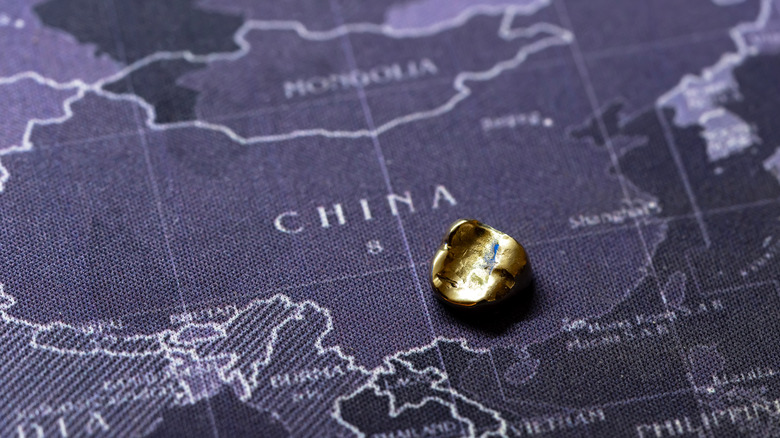
China stuck gold in 2025 — literally. The Asian nation announced three major gold deposits during the calendar year, namely: the Dadonggou deposit in Liaoning province, officially confirmed in November, which could house up to 1,500 tonnes of gold worth $192 billion; a 1,000-plus-tonne deposit in the Kunlun Mountains in Xinjiang province, first announced in the journal Acta Geoscientica Sinica; and an undersea gold field off the Jiaodong Peninsula in Laizhou county, Shandong province first reported in December. Authorities did not disclose the size of the latter, but did claim that it's the largest such example in Asia, contributing to Laizhou's claimed total reserves of more than 3,900 tons.
These finds came hot on the heels of a massive 1,000-tonne find in late 2024 in Hunan province that scientists claimed was the largest precious mineral deposit in the world — later superseded by the Dadonggou discovery. This particular reserve alone was allegedly worth $83 billion when it was announced, not least thanks to high-grade gold deposits of up to 138 grams per metric ton of rock.
For context, the World Gold Council estimates that humanity has mined only about 216,265 tons of gold, so these discoveries are quite significant. Together, they could help China maintain its position as the world's top gold-producing nation and ensure the world continues to have enough gold to use in consumer electronics. However, it's worth noting that not all of these deposits, or their supposed values, are guaranteed.
Not everything is set in stone
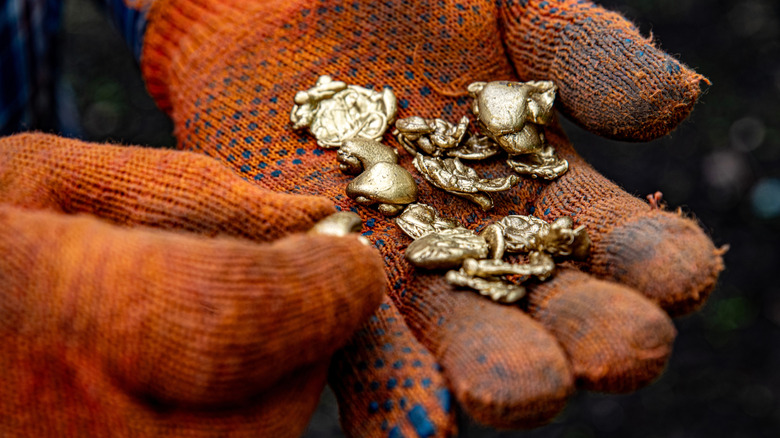
The most important thing to bear in mind is that these huge numbers have yet to be confirmed. The Hunan province gold field's 1,000 tonnes, for example, is merely an estimate. The initial discovery was only 300 tons, with the additional gold derived from 3D modeling, the accuracy of which is unconfirmed. The situation with the Dadonggou mine is similar, as the headline-grabbing 1,444-tonne figure is merely a projection based on 15 months of exploratory drilling. Chinese officials are confident that the Dadonggou deposit's low-grade, low-effort mining will pay off in the long run, but the near-1,500-tonne total doesn't guarantee it. There's also the general fact that just because the gold is there doesn't mean all of it is feasible to extract.
In an email to The Northern Miner regarding the Hunan deposit, the World Gold Council's John Reade opined that "The 1,000-tonne potential resource sounds aspirational," adding that "Much more drilling would be needed to turn this into a reserve." Reade also pointed out that China uses different methods for mineral disclosure, meaning that its numbers don't align with global standards used by other nations.
Gold isn't the only precious mineral China allegedly has in abundance, either. It announced a massive 490-million-tonne lithium ore deposit in November 2025, which dwarfs the 43 million tonnes discovered in Germany earlier in 2025. Given that there doesn't seem to have been any international verification of these finds, though, it's best to take these announcements with a pinch of salt. Only time will tell whether China is sitting on as much gold (and lithium) as it claims.