

The Unsettling Reason Why Taiwan Grounded Its F-16 Fleet For A Week
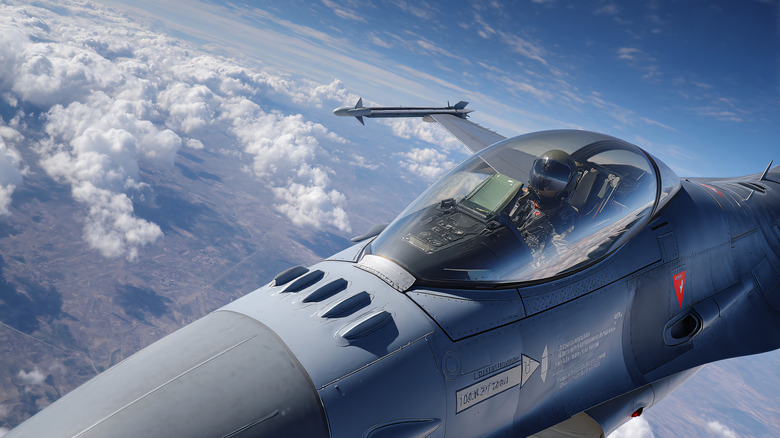
In early January 2026, Capt. Hsin Po-yi of Tawain's Air Force went missing along with his F-16 during a nighttime training mission. It appears that a malfunction with the jet's main onboard computer caused Hsin to deviate from formation after he and his group entered cloud cover over the northeast portion of Taiwan. The group took off on their mission around 6:17 p.m. on January 6 and by 7:28 p.m. Hsin alerted ground control that he was preparing to eject from the F-16V, but they lost his signal only seconds later.
The Air Force quickly launched a search and rescue mission, setting up an emergency response center, to find both the pilot and aircraft, but haven't had any luck as of this writing. The best they've gotten have been brief, intermittent signals from the plane's Flight Data Record, often referred to as the little black box. Unfortunately, those signals haven't been enough to pinpoint an exact location.
As a result, the Taiwanese air force, one of the many militaries that buys F-16s from the United States, grounded its entire F-16 fleet. In the time that the fleet was grounded, the air force conducted tests and ran flight crews through maintenance training. Each F-16 passed inspection, prompting the Taiwanese air force to clear its fleet to fly as of Monday, January 12, 2026.
Taiwan's F-16V program
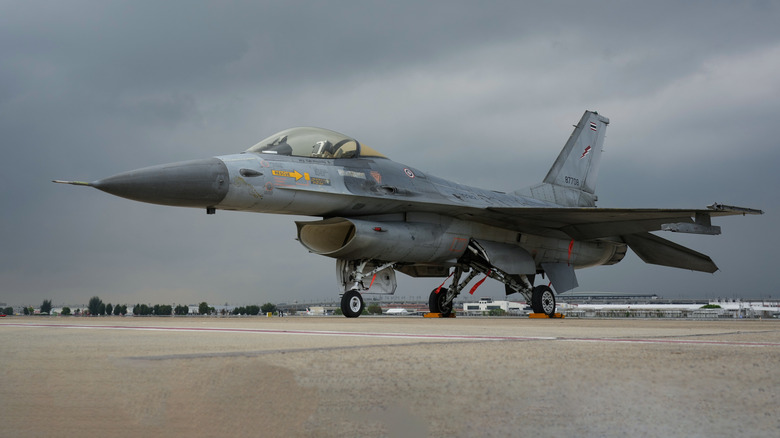
Taiwan might not fly the most F-16s out of every other military, but it was the first country to field combat-ready F-16s upgraded to the F-16V (Block 70-72) configuration, modifying its existing inventory of 141 F-16A/Bs to the new standard. The Viper upgrades put the F-16 in a position to hold its own against fifth-generation fighter jets like the F-22. It comes with a system — the Integrated Viper Electronic Warfare Suite (IVEWS) — that protects it against electronic warfare threats, and it can easily be upgraded when needed to meet freshly developed EW tactics in the field.
Nathan Frock, the Air Force Life Cycle Management Center's acting security assistance program manager for the Taiwan F-16 retrofit program at the time said (via Air & Space Forces Magazine), "Additional modifications to the aircraft include a slew of structural upgrades to the wings, fuselage and landing gear that make the aircraft more capable and sustainable. It also allows for a heavier takeoff as well as increased landing weight."
This entire upgrade process, which was completed in December 2024, is intended to bring Taiwan's F-16s to the same level as America's F-16 inventory and deter the People's Republic of China from moving against Taiwan. Members of Congress sent a letter to the Secretary of the Air Force in 2023, saying, "Taiwan urgently needs these new and upgraded aircraft, and a stronger, more resilient Taiwan will improve stability across the Taiwan Strait."