

5 Clever Ryobi Accessories You Can 3D Print At Home

We may receive a commission on purchases made from links.
There's nothing wrong with using a 3D printer to whip up some fun stuff here and there. That said, these machines have come a long way over the past decade, enabling users to print functional items as well. In fact, if you're an avid tool-user, you can get a lot more than you might think out of a 3D printer. Talented 3D model designers have made it possible to enhance the tool offerings from brands like Ryobi without having to spend additional money on official accessories.
3D printed Ryobi accessories come in a variety of forms. Some make a tool easier to use, others exist to improve organization, and others solve problems you may not have known you had. Unfortunately, some accessories should be avoided. For example, while Ryobi battery adapters do exist and can work, 3D-printed ones can get especially risky. Using one runs the risk of harming yourself, the battery, or the tool it's in, since, as great as 3D printing is, all it takes is a poor design or incorrect materials to make things go wrong.
Fortunately, the following 3D-printed Ryobi accessories have no such track record. These are solid options that many Ryobi users have tried with great success.
1. A Ryobi drill bit mount
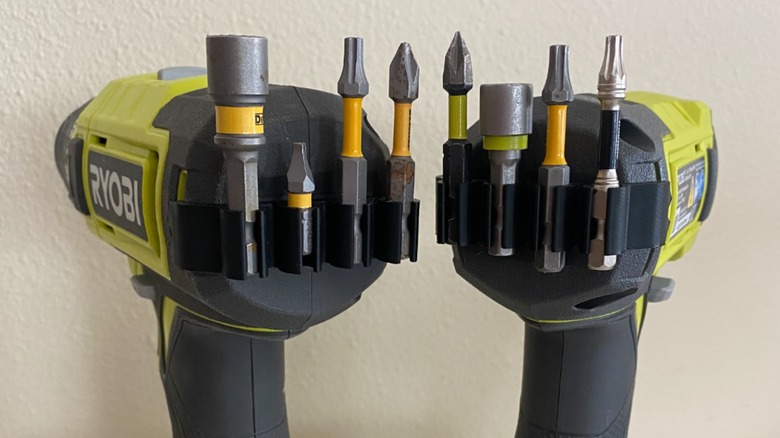
Drill bits can be just as frustrating as they are essential. If you need multiple on a job, they can get mixed up in your pockets or even be lost if you set them down. This is where a Ryobi drill bit holder can be highly beneficial. Such an attachment, like the one by user 401Unauthorized on MakerWorld, can clip onto the back of your Ryobi drill and securely hold all the bits you need. They're both in sight at all times and easily within reach when it's time to replace. This specific print can hold up to four bits at a time and is available in two versions for use with Ryobi drills and impact drivers.
As of this writing, this print has over 1,600 downloads and over 1,200 prints, with MakerWorld reviewers giving it high praise across the board. The vast majority of 3D printers connected to their Ryobi drill snugly but not too tightly and had no trouble holding onto their drill bits. Some even tried different Ryobi drill models than those specified in the initial post, with mixed results. This model is recommended for printing in Polymaker PLA Pro, though the poster also notes that ABS or PETG would work fine.
2. A Ryobi router guide
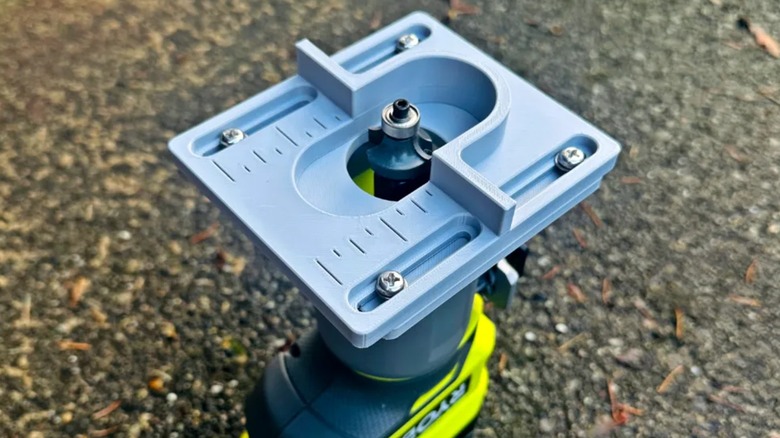
While the different types of wood routers available aren't particularly complex, they can still take some getting used to. Those new to them might struggle to use them effectively as they refine their approach to using this woodworking tool. If you're looking for help using a Ryobi router, especially the Ryobi 18-volt ONE+ compact router, a 3D-printed Ryobi router guide could be the solution. The model from MakerWorld user V-Maker features an adjustable straight edge that makes bevels and chamfers easier to cut, reducing the challenges that can arise when cutting them freehand.
Before printing, please note that there are some prerequisites to complete. First, you should get ahold of four M5 screws at least 10 millimeters long, along with four M5 Washers. Also, you'll need to print out V-Maker's Ryobi router 4-inch square base, which the guide will connect to with the aforementioned hardware. The guide model currently has 1,200 downloads with over 600 prints, and most users have given it their seal of approval. Reviewers praise its shape, sturdiness, and effectiveness at achieving a smooth, straight edge. Users had no trouble with it, made from materials like PLA-CF, PETG, and ABS.
3. Mountable Ryobi tool holders
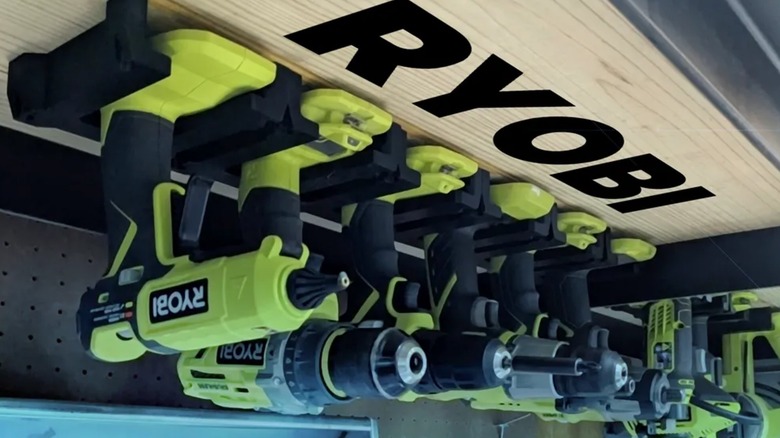
To keep your Ryobi tools clean, intact, and easy to find, proper organization is key. There are a few budget-friendly ways to organize your garage tools, but if you're willing to spend a bit on filament and have a game plan for your setup, some 3D printed tool holders can go a long way. On Printables, user Jarrari created their own design for a tool holder that is simple yet highly effective at holding most Ryobi power tools. All you need before you print them is a set of four wood, self-tapping countersunk screws, at least 20 millimeters long, with 5mm diameter heads. Jarrari also recommends using longer screws if you're concerned about the weight of the tools.
To use these holders, determine where you'd like to mount them. The post explains that they can be screwed into a wall or the underside of a cabinet or workbench. Once mounted, simply slide your tool in by the underside battery compartment and you're all set. Over 11,600 people have downloaded this file, and over 100 have printed it. Reviews praise the holders' strength, ease of printing, and durability, though there are some tools it's incompatible with. Material-wise, PLA is recommended, though PETG or ABS are said to be more suitable for heavier-duty storage.
4. Ryobi hand vacuum nozzles
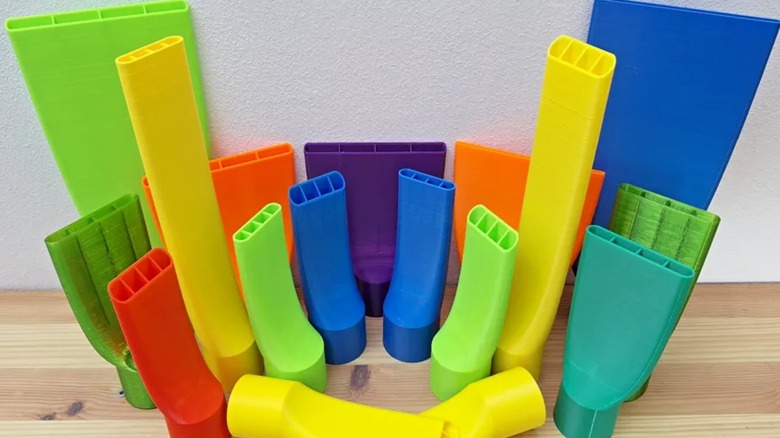
Not only is Ryobi a line known for delivering strong power tools, but it also offers a range of cleanup appliances for sale. For example, the Ryobi 18V handheld vacuum aims to clean up spots of dirt, dust, and debris from hard-to-reach areas. It stands to reason the vacuum can handle most cleanup jobs as-is, but some folks have found ways to improve it. MakerWorld user martin.korinek came up with a series of vacuum nozzles for models from various tool brands, including some for the aforementioned Ryobi model. The description states that the Ryobi vacuum uses the 32 mm nozzle barrel connector, so if you plan to print, ensure you select the compatible version.
Overall, this print has over 5,100 downloads and 2,600 prints, and for those who selected the Ryobi-compatible file, it appears to be a worthwhile creation. It connects securely to the hand vacuum after printing, and the process is straightforward. The description lists materials like PLA, PETG, and ASA as perfectly suitable for this print, with approximately 30 grams of filament needed per nozzle. It's also worth noting that the post states that a 0.6 mm print nozzle is preferable to a 0.8 mm one in terms of material usage and print time.
5. Mountable Ryobi battery holders
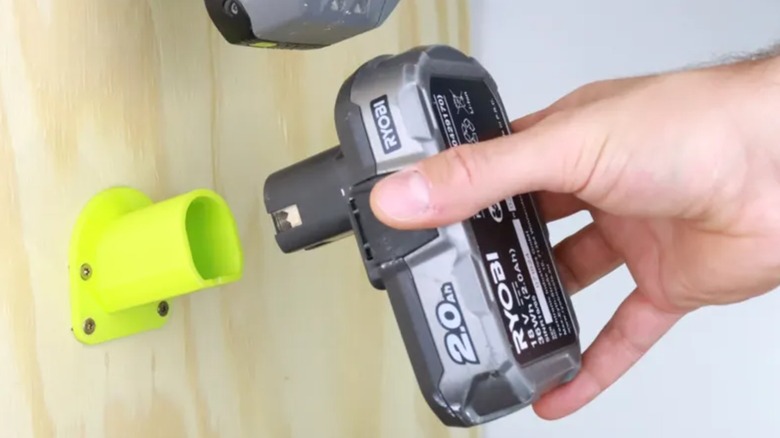
As with tools, organization is critical for Ryobi batteries as well. They need to be properly stored when not in use, otherwise you risk your units sustaining damage and possibly not reaching the Ryobi battery's average lifespan. 3D-printed battery holders are one solution for keeping your batteries organized and properly stored, and there are multiple tested and trusted options available. For instance, user Manicken.se on MakerWorld shared a wall-mountable battery holder design that allows the stems of Ryobi batteries to slide in and fit securely. It's intended for all Ryobi ONE+ 18V batteries.
Additionally, this design includes additional features to benefit your batteries. For one, the holders are mounted at an angle, which distributes weight properly so the battery doesn't suddenly fall out. The inside of the tube is also closed at the wall end, providing an additional layer of protection for the battery against water, dust, and similar contaminants, should anything slip between the wall and the mount. This design currently has over 4,800 downloads and over 3,600 prints, with most who printed it finding great success. The design is widely praised for its snug fit and sturdiness, with PETG named one of the strongest printing materials for this job.
Ryobi may have a lot of bases covered beyond power tools themselves, but this hasn't stopped folks from getting crafty in the accessory department. With a 3D printer and the right files, your Ryobi tool and battery use and storage can go from pretty good to great.