

New Report Shows Just How Few Users Actually Want AI On Their Phone
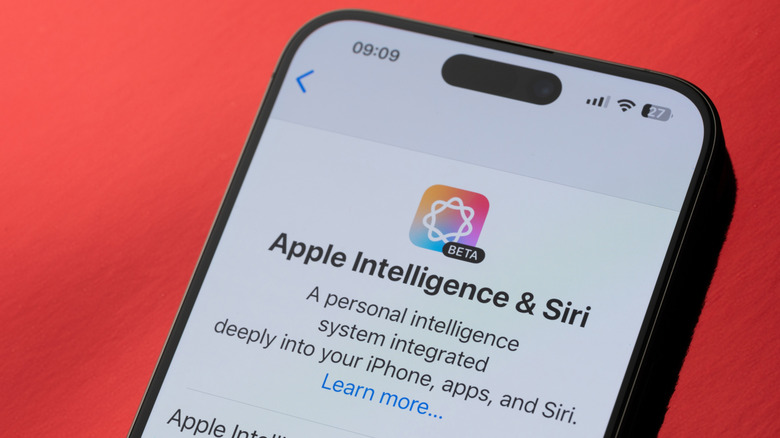
Listen to any recent keynote from any tech bigwig, and you'd start to believe everyone on the planet is desperate to have a chatbot baked into their toaster. Smartphones have arguably become the biggest battleground for all of this, with Apple, Google, and Samsung all racing to make AI the centerpiece of their latest devices.
It may almost get you scratching your head — after all, the reality on the ground and what you've seen on social media are different. Aren't they? Well, a recent report from Circana, a consumer research firm, has basically confirmed that. It found that while 86% of U.S. consumers aged 18 and above are aware of the AI functions their devices can perform, a full 35% want absolutely nothing to do with it. And the reasons are pretty telling.
Of the consumers who are opposed, nearly two-thirds said their devices already do everything they need. Another 59% pointed to privacy as a concern, and then 43% said they don't feel like paying extra for features they didn't ask for in the first place. Only 15% said the tech seemed too complicated. You'd be able to tell by now that most folks seem to understand what AI is just fine, they just don't particularly care to have it on their phone.
That said, 65% of AI-aware consumers did express interest in having those features on at least one of their devices. Moreover, as it's been the case historically with shiny new tech, it appears that the youngsters are more likely to adopt AI. The figure jumps to 82% among 18-to-24-year-olds. "AI is still emerging and is currently more of a nice-to-have feature, as opposed to a core decision driver," said Sara Rosenman, a senior analyst at Circana.
Apple is betting big on AI anyway
The report comes not long after Apple announced a major collaboration with Google — one where the next generation of Apple Foundation Models will actually be built on Google's Gemini technology and cloud infrastructure, according to a joint statement from the two companies. So far, Apple Intelligence has been limited to basic functions like the controversial notification summaries, which, as you may guessed, grew into one of the most hated features in iOS 18. The Gemini-powered Siri is expected to roll out sometime later this year, and many users are actually celebrating that new version of Siri. Expect a bunch of other AI features to accompany it when it arrives.
All this is landing at a time when the gap between what companies are building and what people actually want feels wider than it's really ever been. It's not just survey data telling that story, either. Moreover, Apple is far from the only company drawing flak for its AI push. Microsoft is getting hate for the way it's pushing Windows users to use AI-powered features like Copilot and Recall, too. Over on the company's own support forums, a thread titled "Why don't we get a choice to refuse AI?" racked up dozens of heated replies from users frustrated with the way AI is being integrated into Windows. One comment stands out in particular — it's in all caps and says that people shouldn't have to comply with features they never asked for.
There's a money problem, too
Then there's the financial side of all of this. A J.P. Morgan report from late 2025 (via Tom's Hardware) estimated that the AI industry would need to generate roughly $650 billion in annual revenue just to deliver a 10% return on the investments that companies are expected to make through 2030. To put that in some perspective, the bank said this would essentially be the equivalent of charging every single iPhone user about $35 a month in perpetuity.
And as Circana's own findings suggest, consumers aren't exactly lining up to open their wallets for AI features right now. Of course, none of this means AI is going away anytime soon. But it does suggest that the companies pushing hardest to make all of this happen might want to slow down a bit and figure out what people actually want before pouring more billions into features that a third of their customers would rather not have. "Innovators must establish key functionalities and trust for AI to become a prominent component of consumers' ecosystems," concludes Rosenman.