

Nikon Z5II Vs Canon R8: Which Mirrorless Camera Should You Buy?
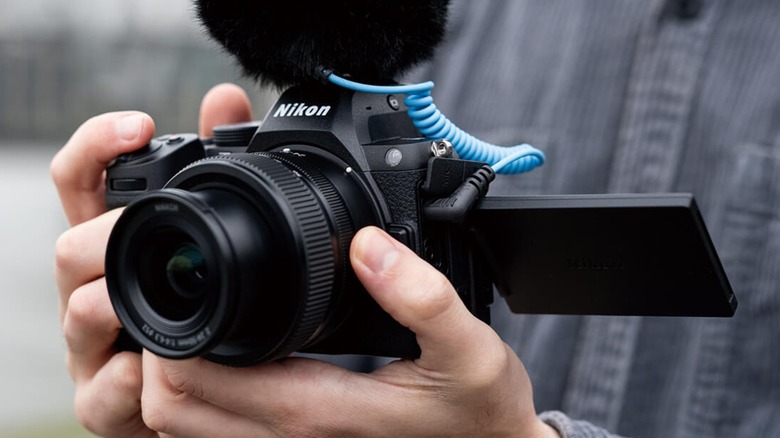
If you're a hobbyist photographer and want to upgrade from your smartphone, you're probably considering a DSLR or mirrorless camera. And, if you can afford to spend a little bit more, you're probably looking at full-frame cameras whose sensors mimic traditional 35mm film. These full-frame cameras have several benefits over cropped-sensor cameras, including a wider field of view and a shallower depth of field — the latter useful if you want your subjects to pop out from their backgrounds.
Nikon and Canon are among the most popular camera brands, so it's natural to consider their entry-level full-frame cameras, the Canon EOS R8 and the Nikon Z5II. These are priced similarly: the Canon costs $1,649, while the Nikon retails for $1,849.95. Both are often on sale, too, meaning you can probably get them for even cheaper.
Although I primarily use a Canon EOS 200D Mk II, which is the cheap yet high-quality digital camera we recommend, I think the Nikon Z5II is the better choice. That doesn't mean that one or the other takes bad images; it's just that the Canon has more drawbacks than the Nikon. The Canon is still a great option if you already have Canon gear, though, especially since most of its weaknesses are still acceptable or easy to overcome. So let's compare both cameras and see how they stack up.
I made this choice based on two decades of experience using various cameras from Canon, Nikon, and other brands. On top of that, I've worked professionally as a studio and wedding photographer, and I still work as a product review photographer and enjoy street and travel photography in my free time.
How different are the two cameras?
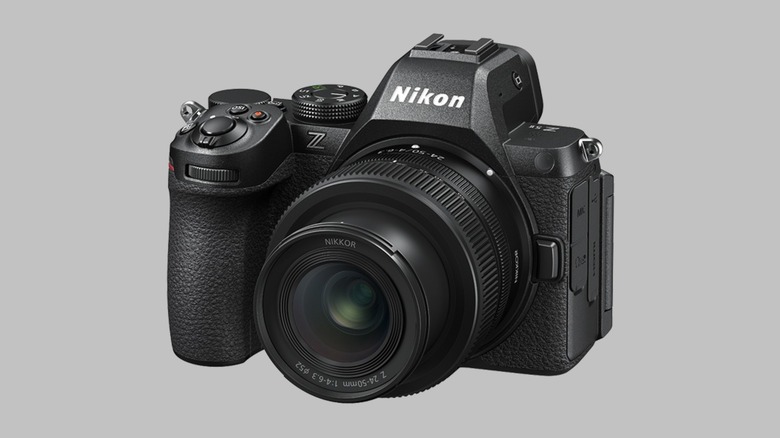
Even though these two cameras come from different brands, they are quite comparable. Both are mirrorless cameras, shoot 24-megapixel images, have the same ISO range (50 to 204,800), and have similar dimensions. However, they also have several differences. For example, the Nikon Z5II offers in-body image stabilization, has a slightly larger LCD screen, faster continuous drive (14.0 fps vs. Canon's 6.0 fps), and two SD card slots. On the other hand, the Canon EOS R8 has more focus points (1,053 vs. Nikon's 299), a much faster maximum electronic shutter speed (1/16000 seconds), and is significantly lighter at just 461 grams (1.02 pounds). The Nikon, in contrast, weighs 700 grams (1.54 pounds).
We reviewed the Canon EOS R8 and found that the camera offered reasonably good performance at a relatively low price. However, it also has a few drawbacks, like its relatively small battery only letting you take 150 to 290 photos on a single charge. This means you'll need to bring extra batteries or a power bank, especially if you plan to shoot all day or are spending a weekend in nature without electricity. Another downside we discovered is that the camera tends to overheat when you're recording at its highest settings.
While the Nikon is about $200 more expensive, it offers some improvements over the Canon. It has longer battery life, rated for around 330 images on a single charge. There also doesn't seem to be any evidence of the Nikon Z5II having overheating issues, either, based on expert reviews. And while the Canon already has a decent electronic viewfinder, you might find that the Nikon's significantly sharper viewfinder with higher magnification will make it easier to shoot without the LCD screen.
You shouldn't sleep on the Canon camera
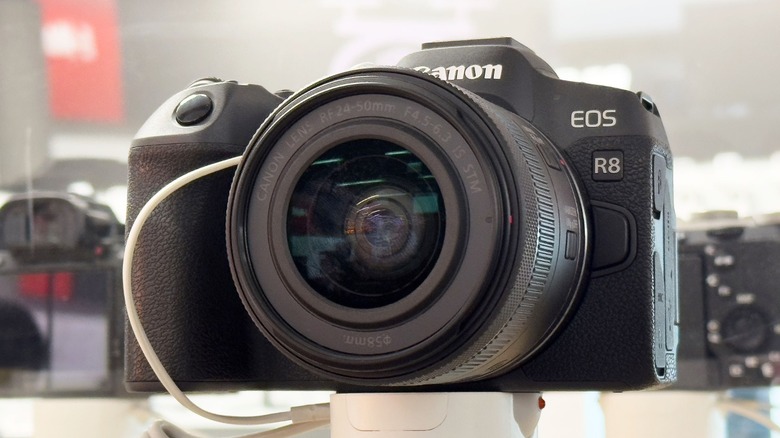
The primary reason I recommend the Nikon Z5II over the Canon EOS R8 is the latter's shorter battery life and tendency to overheat when recording 4K video. But if you don't mind bringing extra batteries and don't plan on recording long vlogs, the Canon EOS R8 is still a good choice — in fact, it even made our list of the best mirrorless cameras. You might also appreciate the R8's lighter weight, which makes it ideal for travel and street photography, especially if you plan to stick with prime lenses. It's also about $200 more affordable than the Nikon — savings that could go towards your next lens.
Of course, if you've already invested in a Canon or Nikon camera body and bought a few cheap prime lenses to add to your gear, you should probably stick to the brand that you already own, unless you're willing to buy new lenses and accessories. After all, the two cameras are closely matched technically, so raw performance will be similar.
Lens variety is closely matched, too. Both Canon and Nikon have 43 compatible lenses — RF-mount and FX Z-mount, respectively – in their product catalogs. If that's not enough, you can buy an official Canon EF-EOS R or Nikon FTZ II mount adapter, allowing you to use the many other lenses both brands have released over the years. This means you can purchase a much more affordable used camera lens (as long as you know what to look for) to expand your collection without breaking the bank.
How I chose my recommended camera
I first evaluated both the Nikon Z5II and the Canon EOS R8 based on expert reviews, including the ones here on MMtech Online. I then combined these with my professional and hobbyist photography experience, which allowed me to identify and recommend a camera that works well in most situations.
I've used Canon, Fujifilm, Nikon, and Olympus cameras throughout my life, but I've mostly stuck with Canon. Nevertheless, I recommended the Nikon Z5II specifically because it has better battery life and does not suffer from overheating issues as far as we can tell.
That said, I believe that the best camera is the one you have in your hands right now. But if you are dead-set on buying a new camera and still can't decide between two models here, the best way to determine which camera is for you is to test both and see which one feels better in your hands.