

Pakistan's JF-17 Fighters Are A Hot Commodity – Here's Who's Looking To Buy
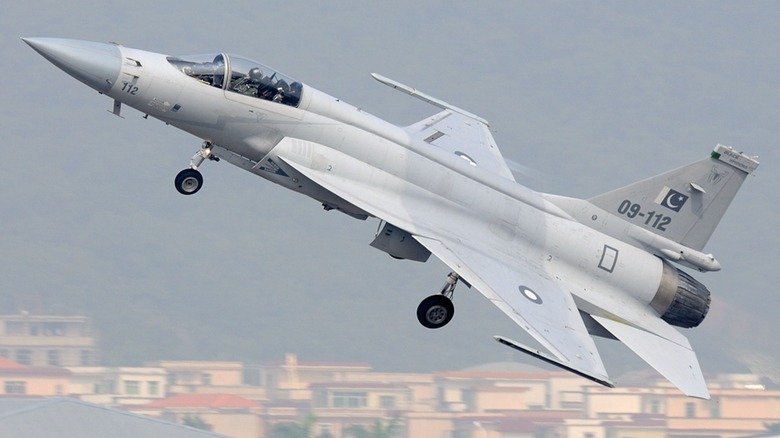
Like many nations around the world with a robust military, Pakistan has developed its own fighter jets. One of its better-known is the JF-17 Thunder, developed jointly with China, which developed its own version called the FC-1 Xiaolong. This fourth-generation fighter is a multirole single-engine aircraft with widespread capabilities, and is Pakistan's successor to the American-made F-16 Fighting Falcon. Pakistan produces around 20 JF-17's per year, which it began operating in 2007.
Pakistan produces the aircraft (the "JF" stands for "Joint Fighter") and has sold many to various nations around the world since its introduction. In early 2026, several arms sales elevated the JF-17 to more customers, making it one of the hottest commodities on the world's arms marketplace. This is partly due to the manner in which it was developed, as it was done entirely without aid from the West. The JF-17 fires Pakistani missiles, drops Pakistani bombs, and comes without any reliance on the United States. This has made the JF-17 a particularly desired aircraft for several militaries.
These include those belonging to Bangladesh, Indonesia, Iraq, Libya, and Saudi Arabia. Each of these nations and others has expressed interest in the JF-17, which already flies for Azerbaijan, Myanmar, and Nigeria, though in small numbers. The increased interest in Pakistan's joint fighter will likely push the nation to increase its manufacturing and supply chains to support potential sales, as the JF-17 is quickly becoming the go-to joint fighter for the aforementioned countries. Pakistan confirmed that negotiations are underway, and it was made clear that China is a consenting partner.
The JF-17 is the new favorite in international arms markets
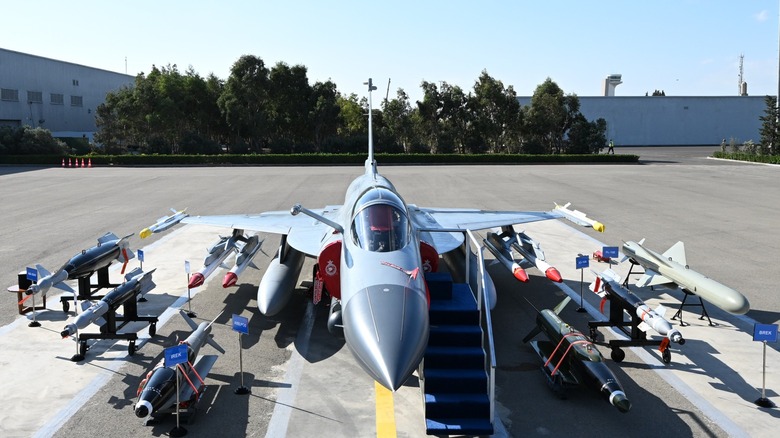
Multirole joint fighters are desired by the world's militaries because they can complete numerous missions across a variety of operational environments, and the JF-17 Thunder is no exception. The aircraft is somewhat similar to China's J-10, though its several differences make the JF-17 more desirable. The Thunder costs between $25 and $30 million each, and they're armed to the teeth with with a GSh-23 dual-barrel 23mm cannon and seven hardpoints (four beneath each wing and one beneath the fuselage).
These accommodate a payload capacity of more than 8,150 lbs., enabling the JF-17 to carry PL-12 radar homing medium-range air-to-air missiles (AAM), a variety of different types of bombs, anti-radiation missiles, anti-ship missiles, and/or rocket launchers with a laser designator pod. Additionally, they can carry short-range AAMs of various types. They also possess a variety of countermeasures, sensors, and other equipment.
One of the reasons the JF-17 is being eyed by a myriad of countries is its relatively low cost. Its price tag is a steal compared to that of the U.S.-sourced F-16, which is the most comparable fighter in terms of performance. The F-16's most recent variant is considered a 4.5-generation aircraft and may be considerably more capable, but they cost a whopping $63 million each. Buying the JF-17 offers a 2-to-1 aircraft advantage in terms of dollars spent; it also comes without the reliance on the U.S. for maintenance, upgrades, or arms, making it ideally suited for many countries around the world.